"You deserve a break today, so get up and get away to McDonalds."
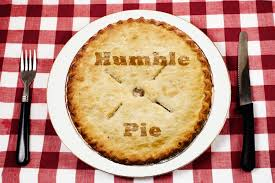
We've been hearing this jingle for so many years that I'll bet many of us could sing the whole song without Googling the lyrics, or at least know the melody well enough to have sung this line as we read it. This slogan is about as American as apple pie. We deserve apple pie and we deserve a break today. Advertisers are always telling us that we deserve to have what they're selling. They use this word because we're quick to buy in. Yes! I deserve it!
That word "deserve" bothers me because it makes us take things for granted and it makes us do things that hurt other people. And it's exactly the opposite of what the Apostle Paul says in his letter to the Philippians:
5 "You must have the same attitude that Christ Jesus had.
6 Though he was God, he did not think of equality with God as something to cling to. 7 Instead, he gave up his divine privileges; he took the humble position of a slave and was born as a human being. When he appeared in human form, 8 he humbled himself in obedience to God and died a criminal’s death on a cross.
9 Therefore, God elevated him to the place of highest honor and gave him the name above all other names, 10 that at the name of Jesus every knee should bow, in heaven and on earth and under the earth, 11 and every tongue declare that Jesus Christ is Lord, to the glory of God the Father."
Jesus didn't demand what he deserved. Instead he willingly gave that up. Paul says we should have that same attitude. So it's especially disheartening to see churches demanding their right to defy medical advice by meeting together during a pandemic. This isn't following Jesus, it's following McDonalds.
Star Wars, however, gets it right. In The Last Jedi (2017) there's lots of selfless giving going on. Three examples stand out. (**spoiler alert**)
--Vice Admiral Amilyn Holdo (Laura Dern) stays behind on the transport ship while the rest of the resistance fighters leave on escape pods. In true leader tradition she goes down with the ship, but not before ramming it into the First Order's flagship as she jumps into hyperspace, thereby destroying both ships and saving the remaining resistance fighters. I also love that only Admiral Holdo and General Leia know what Holdo is going to do, not caring that some of the others think she's being stupid. Doing the right thing often looks foolish to some.
--Rose Tico (Kelly Marie Tran) makes a similar move to Holdo's when she rams her plane into Finn's to stop him from flying into the First Order cannon. Finn is convinced that his sacrifice will cripple the cannon and save the resistance. Whether Rose thinks Finn's move won't work or she's simply unwilling to let him die isn't clear. Both Finn and Rose are acting selflessly. Sadly, though Finn survives, Rose apparently does not. Sometimes doing the right thing is foolish but we do it anyway because it's the right thing to do.
--Luke Skywalker (Mark Hamill) stands up to Kylo Ren to draw Ren's focus while the resistance fighters escape. When we discover that it's not the real Luke and just a projection, we think he's wisely found a way to help without sacrificing himself. But it turns out that this projection required using up his last ounce of strength, and after it's all over, Luke dies in the way that all the Jedi died before him, he disappears. Is it any less self sacrificing because he knows he will live on as a spirit?
Of course, life isn't always as black and white as it seems in the movies. In the midst of our hard choices, so much can cloud our vision. Sometimes there is more than one right answer. And sometimes the right answer is saving yourself so that you can help others. But if we're saving ourselves at the expense of others, it's probably the wrong choice.
I said "probably" because I don't know everything and I don't know your situation, so I'm not making an absolute statement, even thought I'd like to. I get things wrong sometimes. We all do. I'm thankful that God gives us grace when we mess up. But our mess ups can hurt more than just ourselves, so it's important to try to avoid them.
The Bible's wisdom book Proverbs tells us to, "Trust in the Lord with all your heart; do not depend on your own understanding. Seek his will in all you do, and he will show you which path to take." (Prov. 3:5-6 NLT) Don't make hard choices without talking to God first. Though we didn't deserve it, God sent us Jesus because he loves us too much to lose us (John 3:16) and he longs to help us (Isaiah 30:18).
May God bless your seeking him, and in his Spirit may you overflow with love, joy and hope.
Do you like scary movies?
Intense movies? I must confess
that I don’t. When there are scary
scenes or graphic violence, I usually don’t watch. I put my hand over my eyes. Sometimes
I’ll watch through the crack between my fingers if I can watch at all. Sometimes I even have to cover my ears now,
because TV shows and movies have gotten so good at giving us the sounds that go
with the sights.
For instance, there’s a very good show about an
autistic doctor, The Good Doctor[1],
but this doctor is a gifted surgeon and when he goes into surgery, the camera
goes right into the wounds and I have to cover my eyes.And all the gooey sounds come through as
well, so I tend to talk during those scenes so I don’t hear those sounds,
because I don’t have enough hands to cover my eyes AND my ears.
Most of us
don’t like to watch pain, and we don’t like to experience pain.Understandable.
But in the
passages we read this morning, what
Isaiah is describing is pain.He’s
doing it artfully, poetically.We read from the King James (NKJV) because I
wanted us to appreciate that beautiful poetry.But let’s be perfectly clear.When Isaiah says:
By his stripes we are healed. (Isaiah 53:5)
… I have to point out what that sentence is NOT saying. It is NOT saying this:
or this:
The stripes to which Isaiah is referring are these:
Those are hard stripes to look at. Those are the stripes that come from scourging, being
whipped.Pilate ordered that Jesus be
whipped before he was crucified.This
was not unusual punishment during that time.Today we call this cruel and unusual, and it is.
In the very graphic movie about Jesus that came out almost fifteen
years ago, The Passion of the Christ[2],
this was one of the scenes I watched through my fingers.But I have friends who, though it was hard, made themselves watch because they
didn’t want to turn away from the stark reality of what Jesus endured for each
one of us.He bore that punishment for
us. He knew this was coming, he knew
that coming back to Jerusalem meant facing this, but he came anyway.[3]He told us this himself in John 10:18: "No one takes my life from me (he
said), but I lay it down of my own accord."
He himself bore our sins in his body on the tree, that we might die to
sin and live to righteousness. By his wounds you have been healed (1 Peter
2:24).
Because Jesus, God in the flesh, took on our sins and our
suffering, through our faith and through
letting him touch us, we find healing and forgiveness.Through his resurrection, we too are
resurrected.
“Surely he
has borne our griefs and carried our sorrows” (Is. 53:4)Jesus knows our pain and sinfulness because
he experienced it for us on the cross.
Jesus is explaining all this to his disciples in the passage
we read today in Luke 24.There is a lot happening in this chapter!
·It begins with the woman coming to the tomb early in the morning and finding that the
stone has been rolled away and Jesus has been resurrected.They run off to tell the disciples.
·Meanwhile, two
men who had been following Jesus are on their way back to Galilee, sad that
he has died. Jesus walks with them explaining the scriptures to them, but they
don’t recognize him.Then when they sit
down to eat together, as they break bread together, their eyes are opened, and they see that this is Jesus.So they run back to Jerusalem to tell the
disciples.
·As they arrive and begin telling their story, Jesus
appears among them.Not surprisingly,
they are afraid and confused.Jesus was
dead.They still don’t quite understand
what resurrection means.
Is he a
ghost?There’s not a ghost of a chance that he is a ghost, and to demonstrate that
he isn’t, he shows them his scars and eats some fish.Then Jesus explains to them again what the
scriptures say about the messiah.
Jesus probably includes Isaiah 53, the scripture we read
today, in that explanation. It’s one of many prophecies in the Old Testament
that help us understand that Jesus is the Messiah, and that what happened on the cross was part of
God’s plan for the salvation of us all.
This is God in the
flesh, who knows our suffering and suffers
with us.We can sometimes forget
this because we talk about each person of the trinity in such different
ways.We talk about God in heaven, Jesus
the man who walked the earth, the Holy Spirit who lives in us.They are all different and yet they are all
the same God. God the Father, God the
Son, and God the Holy Spirit are inseparably one God.[4]
God was in
Christ reconciling the world to Himself. (2 Cor 5:19)
And because of this, Jesus’
touch is healing.Even just touching
his robe heals a woman who has been bleeding for twelve years.[5]Throughout the gospels we see Jesus healing
people.Matthew ties that right back to
Isaiah 53 for us:
That evening they brought to him many who were possessed with demons; and
he cast out the spirits with a word, and cured all who were sick. This was to
fulfill what had been spoken through the prophet Isaiah, “He took our
infirmities and bore our diseases.” (Matthew 8:16-17)
Though it is hard to imagine someone enduring so much pain
for us, it is a vivid demonstration of the
redeeming power of sacrificial love.
This is what we see in the movie Frozen (2013).The movie came out five years ago, but our
kids are still enthralled with this movie, still in love with the main
characters, the lovable snowman Olaf
and the two sisters, Anna and Elsa.The sisters have had a difficult relationship, with Elsa mostly isolated
from Anna out of fear of accidentally freezing her because Elsa has something
like the Midas’ touch.Everything she
touches freezes.Despite Elsa
continually pushing her away, Anna doesn’t give up on Elsa, and at the very
end, when Elsa is about to be killed by
a man with a sword, Anna steps in front of the sword.At that same moment, she also touches Elsa
and instantly becomes a block of solid ice…and when the sword comes down, it
hits the ice and breaks into pieces.Nobody is killed by the sword!Elsa has been saved.Anna has sacrificed herself for Elsa.
Sacrificial
love is healing love.This is also
demonstrated in one of the stories that was recently told on the show TheVoice.As contestants prepare to come sing for the
judges, we get to hear their stories, and one contestant, Kaleb Lee,[6]
tells about the pain he felt as a child when he was abandoned by his
father.He found healing through
becoming an adoptive father.He and his
wife adopted a little boy from Nicaragua.
Sometimes
something we think we have dealt with comes back and surprises us. The
movie Forrest Gump has a heart-wrenching scene in which the young
Forrest is with his 5-year-old friend Jenny.They run into a cornfield to hide from her drunken father, and Jenny
prays, “Dear God, make me a bird so I
can fly far, far away from here.”The next day her father, who had been abusing her, is arrested and she
goes to live with someone else. God answers her prayer and improves her
situation, but the painful memories of the abuse remain.Years later she comes back to the small town.She and Forrest, now in their thirties, are
walking near the abandoned shack where Jenny once lived with her father. Jenny
is suddenly overcome by the hurtful memories of that place, and in anger she
throws her shoes at the shack, and then starts picking up rocks and throwing
them at it.Eventually she breaks down in tears.Forrest comments, “Sometimes
there just aren’t enough rocks.”[7]
As
Jenny faces her pain, Forrest, her faithful friend, stays with her in those
difficult moments, like Jesus stays with
us. When we come to Jesus and reflect on the pain he endured on the cross,
we find that we too can reflect on our own wounds and pain in the light of his.[8]
We
talk about bringing our sins and sorrows to Jesus and being healed, and we give
the impression that it’s quick and easy, bring it to Jesus once and you’re
done.In reality, often we have to keep
bringing the same thing to Jesus over and over.I think this is because our hurts are usually built up over time, and
each time we bring that same hurt to Jesus, a layer of hurt gets healed, but there
may still be more underneath.
This
has been my experience.I keep having to
come back to the cross and let Jesus do more work in me.
The
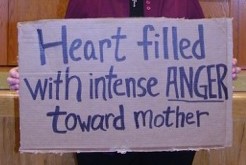
marvel of Jesus working in us over time is something that Carla Davison[9] [who was at that very moment running the projection for worship] has also experienced.Carla was struggling with anger at her mother, anger that had built up over the years.Her healing from that anger also took
time.The Holy Spirit prompted Carla to begin
working on getting rid of her anger as she began to see how it was getting in the way of her relationship with
Jesus. She says: “it started with writing down “I forgive” statements, i.e.
“I forgive my mom for _______” ...even though I didn’t feel any of it at the
time.I trusted that He might get me
there - I wanted to love her…I just couldn’t get past the anger.I had a laundry list of things [to forgive]
and I read them every morning. Then . . . one Saturday [when I went to mom’s
apartment] I looked up at her from where
I was sitting and realized in that moment that the anger was completely gone,
and I was immediately filled with such a tender love for her.I felt like it was God showing me how He
loved her. He removed all the anger. [Carla says] I am so grateful because
after that, I was able to share some very special times with her in her last
years.”
At the church Carla was attending at that time,
they invited people to give their testimonies in a very simple and graphic way
using pieces of cardboard.Carla’s
transformation is described in two statements:
and then…
And maybe the most beautiful demonstration of
the change, is that her mother was there with her in that second picture.
Healing and forgiving
intertwined.Our relationship with God
is healed through his forgiving us.Carla’s relationship with her mom is healed through her finding the
ability to forgive her mother.Jesus tells
us in Matthew 6:14-15: For if you
forgive others their trespasses, your heavenly Father will also forgive you;
but [here’s the hard part] if you do not forgive
others, neither will your Father forgive your trespasses.
We are called to be witnesses to
Jesus’ powerful healing love and comfort and peace and forgiveness. We are more effective witnesses the more we
have seen and experienced Jesus’ work of transformation ourselves, as Paul
explains in 2
Corinthians 1:3-5 (NIV):
Praise be to the God and Father of our
Lord Jesus Christ, the Father of compassion and the God of all comfort, who
comforts us in all our troubles, so that we can comfort those in any trouble
with the comfort we ourselves receive from God. For just as we share abundantly
in the sufferings of Christ, so also our comfort abounds through Christ.
Jesus’ touch is healing and transforming, and a wonderful
testimony to share with the world …if we
are willing to trust him, and let him in.We have a hard time doing that because we are ashamed, or because we
don’t want to deal with the pain, so we keep all that stuff locked away, hiding
it from the world, maybe even hiding it from ourselves, and in the process we
are also hiding it from Jesus.
But we can
trust Jesus with our sin and our sorrow because he knows our pain, and because
he is God and has demonstrated through his death and resurrection that God’s
power is greater than our sin, greater than our shame.God can redeem all of it.
·Sometimes it takes
more time than we would like.
·Some things are not healed in the way we want them to
be.
·The first step is to let Jesus in, to offer all that
is troubling us to Jesus.
So now take a moment to consider....
What do you need to surrender to Jesus today?
In worship that day, we wrote our answers down and brought them forward to lay on the worship table near a cross that the children had made during the children's message. I encourage you to do something similar - write it down, crumple it up and throw it away, trusting that Jesus is taking it from you.
Let’s now bring Jesus all that is not how we would like it to
be
[3] He predicted in Luke 18:31f.,
"Behold, we are going up to Jerusalem, and everything that is written of
the Son of man by the prophets will be accomplished. For he will be delivered
to the Gentiles, and will be mocked and shamefully treated and spit upon; they
will scourge him and kill him."
[4] Guthrie, S. C. (1996). Human
Suffering, Human Liberation, and the Sovereignty of God. Theology Today, 53(1), 22-34.
[5] Matthew 9:20-22 And a woman
who had been suffering from a hemorrhage for twelve years, came up behind Him
and touched the fringe of His cloak; for she said to herself, “If I only touch
his cloak, I will be made well.” Jesus turned, and seeing her he said, “Take
heart, daughter; your faith has made you well.” And instantly the woman was
made well.
After the ordination ceremony, on the
eighth day, Moses called together Aaron and his sons and the elders of Israel.2 He said to Aaron, “Take
a young bull for a sin offering and a ram for a burnt offering, both without
defects, and present them to the Lord.3 Then tell the
Israelites, ‘Take a male goat for a sin offering, and take a calf and a lamb,
both a year old and without defects, for a burnt offering.4 Also take a bull and a ram
for a peace offering and flour moistened with olive oil for a grain offering.
Present all these offerings to the Lord because the
Lord will appear to you today.’”-Leviticus 9:1-4
“Because the Lord will appear to you today.”Nothing like setting the expectations
high!But Moses knew what he was talking
about and God showed up in a big way:
Then Moses and
Aaron went into the Tabernacle, and when they came back out, they blessed the
people again, and the glory of the Lord
appeared to the whole community.Fire blazed forth from the Lord’s presence and consumed the burnt offering and the fat on the
altar. When the people saw this, they shouted with joy and fell face down on
the ground. –Leviticus 9:23-24
Wow!Our God is truly
a consuming fire!
We don’t like to read Leviticus very much because it’s
tedious reading about all these burnt offerings and a bit gruesome reading
about all the details of the butchering and sacrificing.But there are these nuggets of joy nestled in
between the tedious details.And it’s
precisely because the people were obedient to God’s directions about preparing
themselves to approach him that they were able to have these moments of joy
when God makes his presence known.
I’m reminded as I read Leviticus to be thankful anew for
Jesus’ sacrifice once for all that makes it so that we don’t have to go through
all the rigmarole of the Levitical laws anymore (Heb. 10:10).But I also wonder how often we come with the
expectation of meeting God?Moses doesn’t
say, “Maybe we’ll see God;” he says, “the LORD will appear to you today.”Without the expectation, I wonder if we then
fall short on the preparation and create our own self-fulfilling prophecy?
“God probably won’t show up anyway, so why bother.”
But we have a God who keeps his promises.This is precisely what we celebrate on
Easter.Jesus said he would be raised on
the third day, and indeed he was.And
there are numerous scriptures that encourage us to humble ourselves and turn to
God with the expectation that we will find him if we seek with all our hearts.
(Deut. 4:29, Psalm 9:10, 2 Chron. 7:14, Matt. 7:7-8, Heb. 11:6, James 4:8, et
al)
I wonder sometimes, though, how much we really want to meet
God?Meeting God can be blessing or very
scary.Isaiah was horrified by his own
sinfulness when he was confronted with God’s goodness and glory (Isaiah 6:5)C.S. Lewis describes this nicely in his book Miracles:
“It is always shocking to meet life where we thought we were alone.
“Look out!” we cry, “it’s alive.” And therefore this is the very point at which
so many draw back—I would have done so myself if I could—and proceed no further
with Christianity. An “impersonal God”—well and good. A subjective God of
beauty, truth and goodness, inside our own heads—better still. A formless life-
force surging through us, a vast power which we can tap—best of all. But God
Himself, alive, pulling at the other end of the cord, perhaps approaching at an
infinite speed, the hunter, king, husband—that is quite another matter.”
God in our own image is much tamer and safer than the real
thing, so we keep from having to realize what God is really like by only
allowing ourselves to get within arms distance of him.Maybe this is what happened when the people
following Jesus turned away.They found
out what they were really dealing with and were overwhelmed.This happened to Israel early in their desert
wandering.They were overwhelmed by God’s
glory and asked Moses to intercede for them so they wouldn’t have to face God
themselves (Ex. 20:18-21).At this point
they didn’t have the Levitical laws yet, and they hadn’t done anything to
prepare themselves to meet God, nothing of any sort like the preparations Moses
required of them in Leviticus 9, and as a result they were overwhelmed by fear
instead of blessed by God’s presence.
Maybe they weren’t really expecting to meet God.And maybe we aren’t either, and so we too
come unprepared.We don’t need to
slaughter any animals, just our pride….not that slaughtering our pride is all
that much easier or less messy.I think
the first step is just to admit that we are prideful and that we need to work
on that.God meets us halfway and helps
us with the steps that follow.Just that
little bit of bowing before God puts us in a better attitude to meet God and
have it be a blessing instead of a horror.
May we find our way to humbly approaching God today and may
we expect that he will meet us there and bless our seeking, in Jesus name!